On-Grid
Best for stable grid supply
Uses solar during the day and the grid when generation is lower. It is usually the simplest route to reducing electricity costs.


Authorised channel partner
Solar solutions
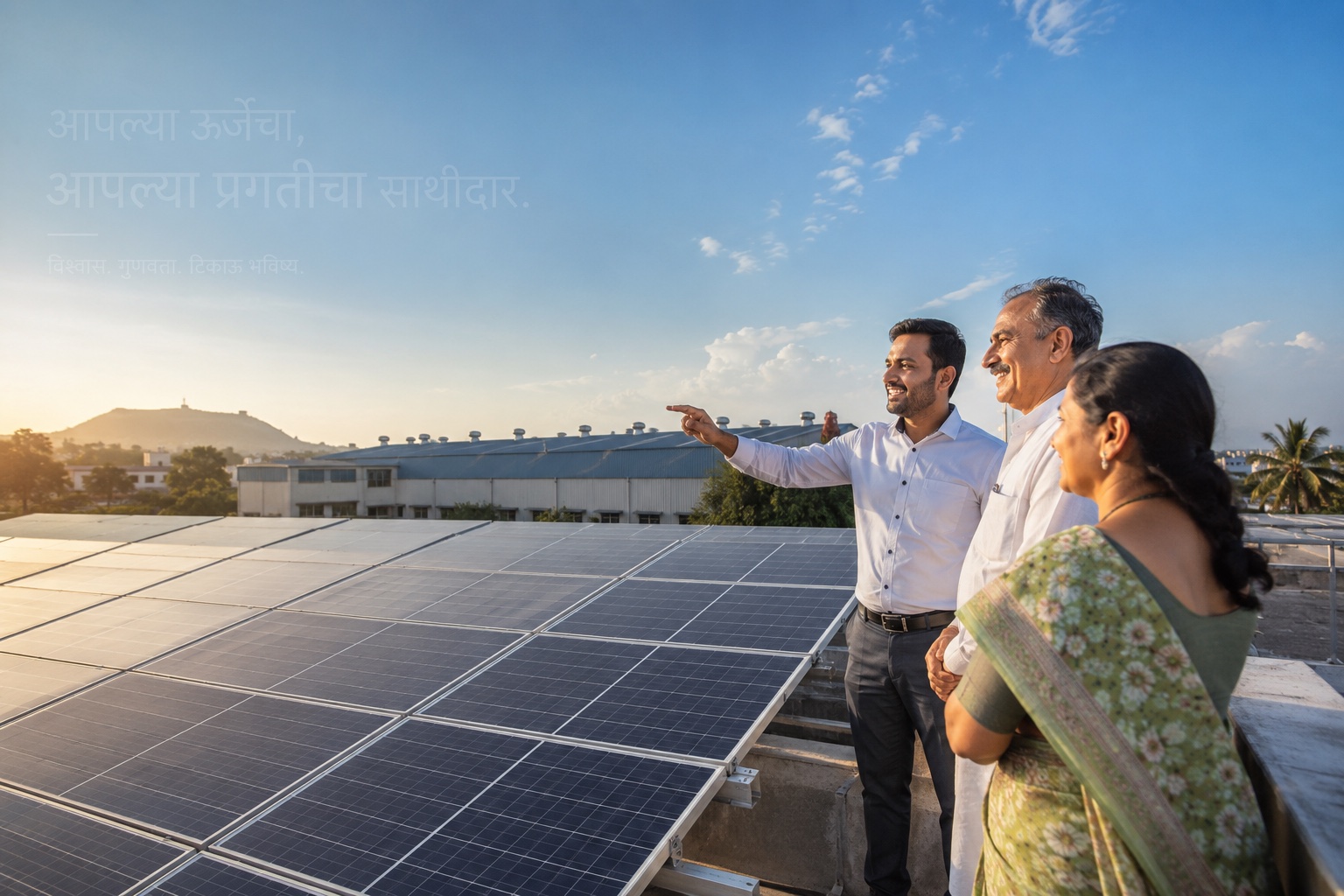
From electricity-bill review and roof assessment to commissioning and long-term care, one accountable team coordinates every solar stage across Kolhapur and Maharashtra.
Get Free Solar QuoteBuilt around the requirement
A home, hospital, school, office and factory use electricity differently. We begin with that difference—then connect system size, roof conditions and project delivery to the requirement.
On-grid, off-grid or hybrid?
Choose based on grid reliability, backup needs, electricity use and budget. A site and load review is still needed before final design.
Best for stable grid supply
Uses solar during the day and the grid when generation is lower. It is usually the simplest route to reducing electricity costs.
Best where grid access is unavailable
Uses battery storage to supply power without relying on a grid connection. Loads and backup duration must be designed carefully.
Best for savings plus backup
Combines solar, the grid and battery storage for properties that need bill savings and selected backup during outages.
| Feature | On-Grid | Off-Grid | Hybrid |
|---|---|---|---|
| Grid connection | Required | Not required | Required |
| Battery included | No | Yes | Yes |
| Power during an outage | No | Yes | Yes, through battery |
| Net-metering suitability | Commonly suitable | Not applicable | Depends on system design |
| Relative upfront cost | Lowest | Higher | Highest |
| Battery maintenance | Not required | Required | Required |
| Residential subsidy | Applicable to eligible homes | Not generally applicable | Only eligible grid-tied portion, if approved |
| Typical return profile | Usually fastest | Slower due to storage cost | Between savings and backup priorities |
| Best use | Reduce bills with a reliable grid | Sites without grid access | Savings plus selected outage backup |
Backup capability, net-metering treatment and battery sizing depend on the final system configuration and applicable electricity-distribution rules. This table is a planning guide, not a technical proposal.
A closer look
The right system is defined by the job it needs to do. Backup, storage and independence add capability—but also cost, maintenance and sizing decisions.
Best for stable grid supply
Best where grid access is unavailable
Best for savings plus backup
A system size connected to how your property uses power.
We review electricity consumption, daytime demand, sanctioned load, roof geometry, shade and access before recommending capacity. The result is grounded in both energy use and buildable roof space.
One team accountable for design, procurement and delivery.
Engineering decisions continue into procurement, construction and commissioning instead of being handed between disconnected teams. That keeps responsibilities clear throughout the project.
Protect performance after commissioning.
Monitoring and preventive maintenance help identify faults, soiling and equipment concerns before they become longer periods of lost generation.
Start with a free review of your electricity bill and property requirement.
Official partner recognition
Authorised Tata Power Solaroof Channel Partner for Kolhapur District
National brand standards. Local project accountability since 2017.